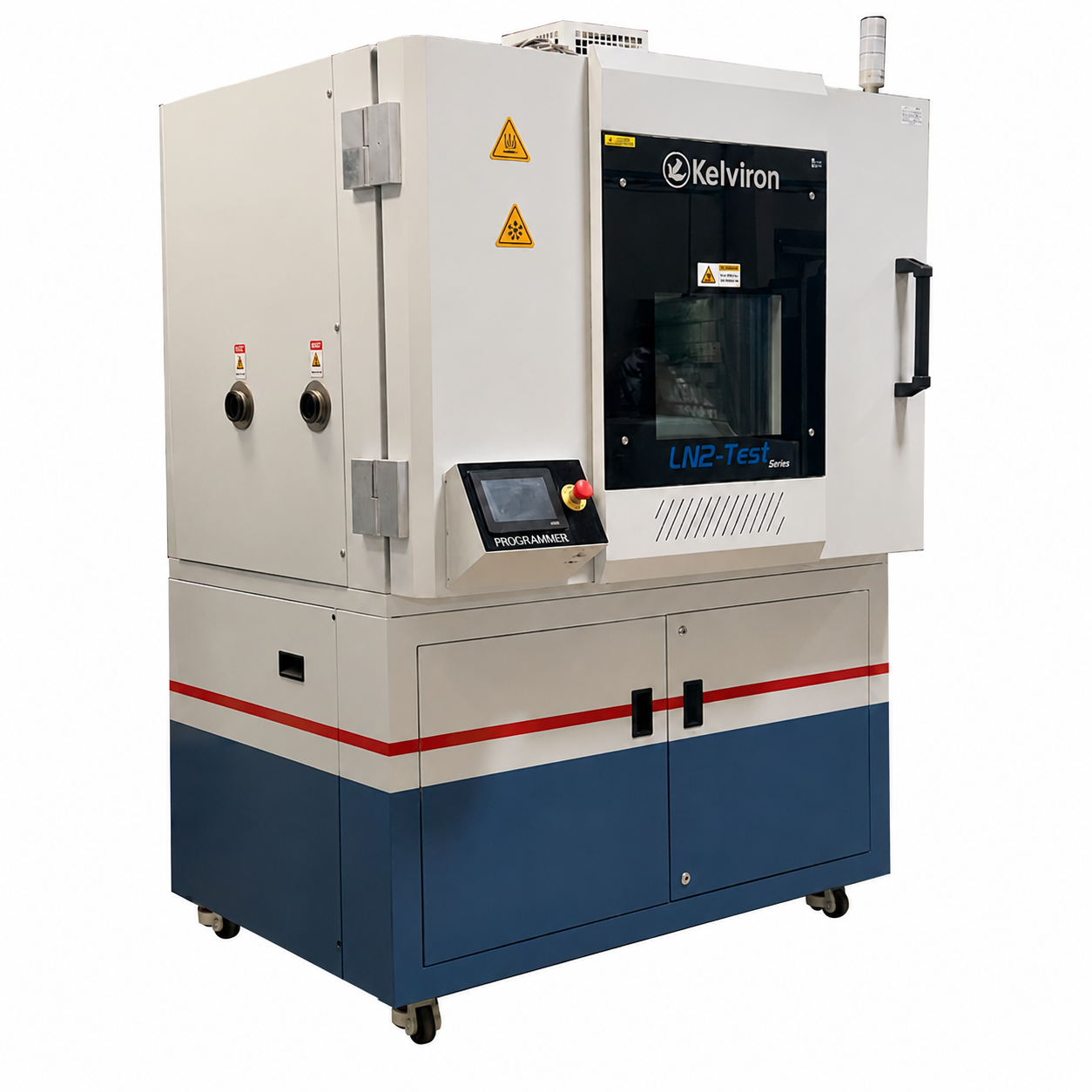
LN2 Thermal Test Chamber
- Model: KTPL/LN2TC-70
- Workspace Capacity: 504 litres
- Inner Size: 1200 mm (W) x 800 mm (D) x 600 mm (H)
- Temperature Range: -69°F to +480°F
- Temperature Accuracy: ±2.0°F
- Display Resolution: 0.1°F
- Temperature Uniformity: <±1°F
- Temperature Gradient: <1.5°F
- Average Heating & Cooling Rate: 5°F/min
- DUT Heat Load: 500 watts
- Load Bearing Capacity: 100 kg
- Control: Red Lion 7-inch HMI & Siemens PLC
- Cooling: Electronically Controlled LN2 System
- Power Supply: 415 V AC, 50 Hz, 3 Phase
LN2 Thermal Test Chamber Manufacturer
Kelviron Technologies' LN2 Thermal Test Chamber is a specially customized environmental testing solution designed for controlled high-temperature heating and cryogenic liquid-nitrogen cooling. Model KTPL/LN2TC-70 provides a 504-litre stainless-steel workspace for evaluating components, assemblies and materials under demanding temperature conditions. The chamber operates from -69°F to +480°F with 0.1°F display resolution and an average heating and cooling rate of 5°F per minute. A programmable Red Lion HMI and Siemens PLC manage temperature profiles, test sequences, data logging, alarms and chamber status. The system is intended for industrial testing, research, product validation and quality-control applications where repeatable thermal exposure is required.
Typical Applications
- Automotive and electric-vehicle component evaluation
- Aerospace and defence product testing
- Electrical and electronic component testing
- Material behaviour and thermal endurance studies
- Thermal cycling and reliability assessment
- Industrial R&D and quality-control testing
Control Instrumentation - Red Lion HMI & Siemens PLC
The chamber uses a 7-inch high-resolution Red Lion TFT HMI together with Siemens PLC control. Kelsoft® provides a password-protected operator interface for program management, test status, trending, alarms and diagnostics. The system supports ramp, soak, duration and wait-band programming; storage for up to 50 programs; up to 30 ramp-and-soak segments; and repeat cycles up to 250. It also provides 16 GB memory-card capacity, 2 GB built-in memory, power resume/automatic restart, online trend graph, alarm history, fault diagnostics, calibration features, USB data download, Ethernet remote access, configurable LAN/IP settings and Excel-compatible data export.
LN2 Cryogenic Cooling System
The cooling system uses an electronically controlled cryogenic solenoid valve to purge liquid nitrogen into the chamber. Special nozzles distribute LN2 through the workspace, while an exhaust damper provides pressure relief. The cooling valve is integrated with the chamber control system so cooling operation can be included in programmed test profiles. The specified LN2 requirement is approximately 10-12 litres per test; actual consumption depends on the test profile, load, starting temperature and duration.
Controlled Heating System
Removable U-shaped stainless-steel sheathed air heaters with brass terminals and Teflon wiring provide controlled high-temperature operation. The heaters are installed in the conditioning plenum so there is no direct heater radiation onto the specimen. Heating is interlocked with air circulation to protect the heating system.
Laminar Airflow and Uniformity
A suitable-capacity fan motor and impeller provide laminar airflow through the workspace. Conditioned air is continuously circulated to support uniform temperature distribution. The specified temperature uniformity is below ±1°F with gradient below 1.5°F across the operating range.
Technical Specification - Model KTPL/LN2TC-70
| No. | Parameter | Specification |
|---|---|---|
| 1 | Nomenclature | Special customized solution for high heating and LN2 cooling thermal applications. |
| 2 | Chamber inner dimensions | 1200 mm (W) x 800 mm (D) x 600 mm (H), 504 litres. Provision to place hydraulic power pack. Ground level to chamber floor: 1000 mm. |
| 3 | Chamber outer dimensions | 1900 mm (W) x 1500 mm (D) x 1900 mm (H). |
| 4 | Temperature range | -69°F to +480°F. |
| 5 | Temperature accuracy | ±2.0°F with 0.1°F display resolution for the entire range. |
| 6 | Temperature uniformity | <±1°F; gradient <1.5°F for the entire range. |
| 7 | Average heating & cooling rate | 5°F/min. Time-based ramp-rate setting for the entire temperature range. Automatic blower for ambient-air inlet to force-cool the workspace. |
| 8 | Heat load from DUT | 500 watts. |
| 9 | Load bearing capacity | 100 kg. |
| 10 | Insulation | 150 mm high-density Rockwool insulation to reduce atmospheric water-vapour condensation on the exterior. Non-hygroscopic construction. Outer-body temperature specified between 20.0°C and 35.0°C during extreme low- and high-temperature conditions. |
| 11 | Chamber interior | 18 SWG, 304-grade stainless steel with completely welded finish. No joints or sharp edges inside the workspace. Joints are leak-proof to help prevent air and water leakage. |
| 12 | Chamber exterior | 16 SWG GI sheet with double-layer powder-coated finish. CNC-made outer body with fine-finished joints and no unnecessary fixture projections. Built-in control panel. Stainless-steel-finish hinges and door locks. |
| 13 | Airflow system | Laminar airflow with suitable-capacity fan motor and impeller for uniform temperature distribution. Conditioned air circulates through the workspace. |
| 14 | Control instrumentation | Red Lion 7-inch high-resolution TFT HMI and Siemens PLC programmer; Kelsoft® software; password protection; screen lock/auto sleep; program edit/view during run; ramp/soak/duration/wait band; up to 50 programs; up to 30 ramp/soak segments; repeat cycles up to 250; 16 GB memory card; 2 GB built-in memory; power resume/auto restart; live graph/trend; alarm history; fault diagnostics; calibration; USB; Ethernet; remote IP access; Excel-compatible data export; selectable log interval; CSPID2 heat/cool module; CMSTRV2 communications module; Ethernet hub. |
| 15 | Cooling system | LN2 cooling system with electronically controlled cryogenic solenoid valve, internal distribution nozzles, programmable control-system integration and exhaust damper for pressure relief. Stated LN2 requirement: 10-12 litres per test. LN2 supply at customer site is by customer scope as specified. |
| 16 | Heating system | Removable U-shaped SS-sheathed air heaters with brass terminals and Teflon wiring. Heating is interlocked with air circulation. Heaters are positioned in the conditioning plenum to prevent direct radiation onto the specimen. |
| 17 | Temperature sensor | PT100 RTD temperature sensor made from 304-grade stainless-steel solid material. |
| 18 | Door & silicone gasket | Heavy-duty right-side hinges with full-front-opening single door. Specially designed silicone gasket on chamber and door, airtight locking arrangement, and double-lined gaskets without corner joints. |
| 19 | Viewing window & lamp | Multi-pane viewing window with four toughened clear glasses, silicone sealing and spacers forming a vacuum window. Defogger heaters with control and internal illumination. |
| 20 | Electrical components | Single Phase Preventer for single phasing, high/low-voltage and phase-sequence protection; L&T contactors; Siemens/ABB MPCB with NO/NC connectors; Unison solid-state relays; individual MCBs; ABB/EAPL SMPS; EAPL compressor start-delay device; 24 V DC mechanical relays for PID outputs. |
| 21 | Safety features | Safety assessment/remediation/compliance support by Rockwell or Pilz; CAT.3 PL-d emergency-stop arrangement; self-monitored contacts; safety PLC monitoring; dual-channel architecture; motion stoppage per ISO 13849 principles; high/low-temperature safety controller with audible warning; emergency stop; automatic N2 purging integrated to O2 sensing; fume exhaust blower with damper; electromagnetic door lock; voltage/phase protection; overload protection; heating MCBs; status tower lamp. |
| 22 | Access port holes | Two 100 mm diameter ports with silicone plugs at the rear and three 50 mm ports for hydraulic lines. |
| 23 | Power supply | 415 V AC, 50 Hz, three-phase. |
| 24 | Shelves & trays | Separate shelf and tray provided. |
| 25 | Caster wheels | Eight caster wheels for easy chamber mobility. |
| 26 | Noise level | <65 dB. |
Construction and Access
Chamber Construction
The inner chamber uses 18 SWG 304-grade stainless steel with a completely welded finish, while the exterior is specified as 16 SWG GI sheet with a double-layer powder-coated finish. The design integrates the control panel into the exterior body and uses stainless-steel-finish hinges and door locks. The workspace is insulated with 150 mm high-density Rockwool.
Door, Window and Access
A heavy-duty right-hinged, full-front-opening door uses a double-lined silicone gasket and airtight locking arrangement. The multi-pane window uses four toughened clear glass panes with silicone sealing, spacers and defogger heating. Rear access is provided through two 100 mm ports with silicone plugs, together with three 50 mm ports for hydraulic lines.
Safety Features
The supplied configuration includes layered temperature, electrical, door, gas and emergency-stop safeguards. Final safety compliance depends on the agreed project configuration, site conditions and applicable assessment.
- Safety assessment, remediation and compliance support by Rockwell or Pilz
- CAT.3 PL-d emergency-stop arrangement with self-monitored contacts and safety PLC monitoring
- Dual-channel control architecture and motion stoppage aligned to ISO 13849 principles
- Independent high/low-temperature digital safety controller with audible warning
- Automatic N2 purging integrated with O2 sensing
- Fume exhaust blower with damper and electromagnetic door locking
- High/low-voltage cutoff, phase protection, motor overload protection and heating MCBs
- Status tower lamp
Safety reference: The supplied specification references AS/NZS 4024.1503:2014 PL-d Category 3 and ISO 13849 principles. Confirm the final machine configuration and project-specific safety assessment before publishing compliance claims.